Understanding the Dot Product
I would like to organize my understanding of the dot product, a concept that came up in engineering mathematics class.
What exactly is the dot product?
First, let us consider what it means to take the dot product of vectors.
내적 | 內積 | inner product | scalar product
The character used for 'product' in Korean originally means to accumulate, but here it means to multiply. There are two definitions of vector multiplication. The dot product treats vectors somewhat as if they were numbers. Yes—we want to multiply two vectors.
Understanding the dot product through physical work
In everyday language, doing work may mean performing labor. In physics, however, work measures what happens when a force moves an object through a certain distance.
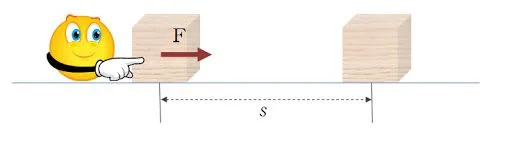
Suppose I apply a force F to a block of wood and move it through a displacement s. The work W that I do on the object is given below.
The complication arises when the force and the displacement do not point in the same direction. Imagine the movement shown below.
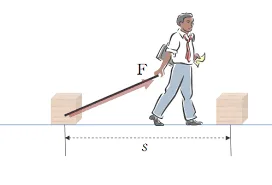
The key idea in physical work is that only the component of force along the direction of displacement contributes to work. With that in mind, we can resolve the force F as follows.
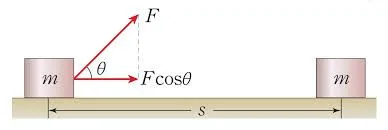
Only the force component along the direction of movement contributes to work, so the perpendicular component does no work on the object. The actual work done by the man is therefore as follows.
The important point is that both F and s are vectors: they have directions. F has a magnitude and a direction, while s specifies both how far the object moves and in which direction.
For these two vector quantities, we can define a dot product consistent with the concept of work above. We define the dot product of F and s as follows.
Let the angle be the angle between the displacement and the applied force.
This gives the definition below. If force and displacement point in the same direction, as in the first figure, the force contributes fully in that direction and the expression becomes the one shown below. Otherwise, multiplying by the cosine of the angle gives the physical quantity consistent with the definition of work.
The geometric definition of the dot product
We can now extend the dot product beyond physics to general vectors. For two vectors a and b, and the angle between them, their dot product is defined as follows.
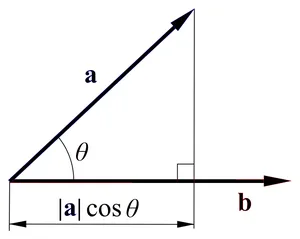
The dot product produces a scalar. Remember that a vector has both magnitude and direction, whereas a scalar has only magnitude. Multiplying two vectors using the dot product therefore yields a scalar with no direction. All the factors on the right-hand side are scalars. This definition also lets us prove that the dot product is commutative.
The algebraic definition of the dot product
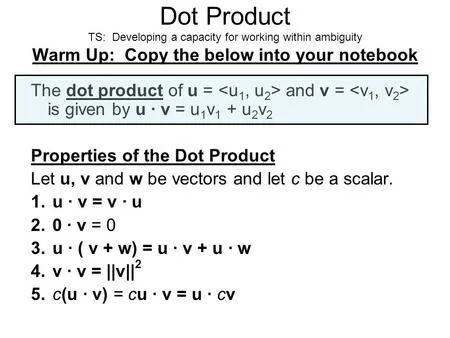
We have explored the dot product through physics and arrived at its geometric definition. But we also know how to express vectors in terms of their components. Naturally, we can express the dot product as a component-wise calculation too.

Properties of the dot product
Comments —