Working Backwards

📌 Beginning Part One
Even the way Amazon analyzes and manages performance metrics centers on customers. Rather than output metrics, it emphasizes controllable input metrics. Monthly revenue and stock price are outputs; reducing internal costs to lower prices, adding new items to the website, and shortening standard delivery times are controllable inputs. Input metrics measure the activities that lead to the desired outcomes before those outcomes appear.
📌 Chapter 1. Management Strategy: Leadership Principles and Mechanisms
The previous year, Jeff had read a report projecting annual internet usage growth of 2,300 percent. Leaving a successful career to start an internet business, he developed his business plan on the way to Seattle. Books had attracted little attention online, but he identified several reasons they suited e-commerce and outlined ways to give book buyers a powerful new experience.
- Books are relatively light and published in fairly consistent formats.
→ They are easy and inexpensive to store, pack, and ship.
- More than a hundred million titles had been published, but even large bookstores such as Barnes & Noble could display only tens of thousands.
→ An online bookstore can offer the selection of physical stores and books of every kind beyond it.
- Large distributors such as Ingram and Baker & Taylor already connected publishers and bookstores. Jeff recognized that their existing infrastructure could be linked to the web.
→ Customers can easily search for, purchase, and receive any book.
- Websites can use technology to analyze customer behavior.
→ They can offer a distinctive, personalized experience to each customer.
From the tone of customer emails to product inspection and packaging, Jeff applied one simple rule to every step: it had to be perfect.
People often ask how Amazonians remember all fourteen principles. It is not because they have unusually good memories. Having to memorize a company's principles is actually a warning that they have not sufficiently permeated the organization. Amazonians know them because they form the basic framework for decisions and actions.
Amazon's leadership principles are not mere slogans. They are the company's living constitution.
- Customer Obsession
→ Leaders start with the customer and work backwards.
- Ownership: Leaders Act as Owners
→ Leaders never dismiss something as someone else's job.
- Invent and Simplify
→ Leaders look beyond their organization, seek ideas everywhere, and do not let a 'not here' attitude constrain them.
- Are Right, A Lot
→ Leaders are willing to seek evidence that disproves their own beliefs.
- Learn and Be Curious
→ Leaders keep learning and always seek ways to improve themselves.
- Hire and Develop the Best
→ Leaders raise the performance bar with every hire and promotion.
- Insist on the Highest Standards
→ Leaders set relentlessly high standards.
- Think Big
→ Small thinking becomes a self-fulfilling prophecy. Leaders articulate a bold direction that produces results.
- Bias for Action
→ Speed matters in business. Many decisions and actions can be reversed and do not require exhaustive study. Calculated risk-taking is valued.
- Frugality
→ Achieve more with fewer resources. Constraints encourage resourcefulness, self-sufficiency, and invention.
- Earn Trust
→ Leaders listen carefully, speak candidly, and respect others. They benchmark themselves and their teams against the best.
- Dive Deep
→ Leaders work at every level, stay close to details, inspect frequently, and question discrepancies between metrics and real-world accounts.
- Have Backbone; Disagree and Commit
→ Leaders must respectfully challenge decisions they disagree with, even when doing so is uncomfortable or tiring.
- Deliver Results
→ Leaders focus on the business's key inputs and deliver timely results at the appropriate quality.
📌 Chapter 5. Working Backwards: Start with the Customer Experience
Working backwards means defining the customer experience first, then repeatedly tracing back from it until the team has a clear picture of what to build. Amazon's main tool is a second form of narrative document called the PR/FAQ: a press release paired with frequently asked questions.
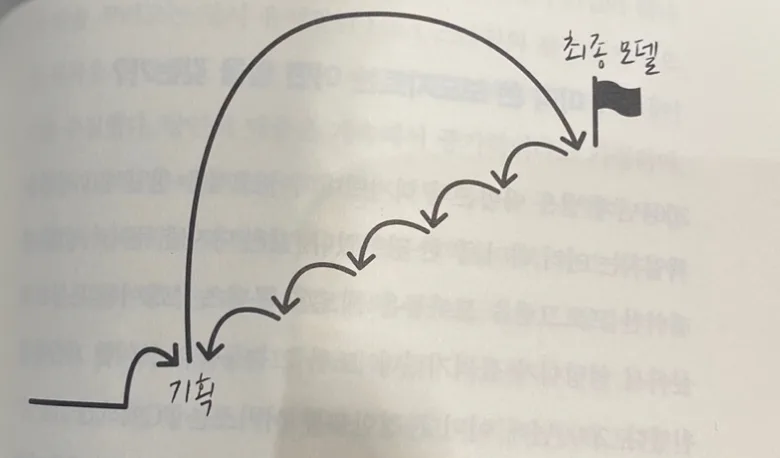
Write the press release that would announce the product to the public as if it were ready to launch, then anticipate difficult questions in the FAQ. Together, these elements establish the customer experience as the starting point.
Bill was eager to launch a new content store for digital music, films, and television programs. Jeff asked where the mock-up was. Bill's team had not prepared one, but now had to. A few weeks later, they met Jeff again with a rough version. A premature mock-up was clearly worse than none at all. To Jeff, a sloppy mock-up demonstrated sloppy thinking, and he said so directly. He did not want the team to rush down the first convenient path they found. He suggested a different approach.
Expressing an idea in writing is difficult. It requires thorough, precise thinking. The document had to describe features, price, how the service worked, and why customers would choose it. Slides could disguise weak thinking; a narrative made that harder. Jeff took the idea further: what if the narrative describing a product concept were treated as a press release?
Organizations usually write press releases at the end of product development. Only then do marketing and sales examine the finished product from the customer's perspective. They list its predetermined killer features and benefits, trying to construct a story that creates buzz, attracts attention, and persuades people to buy. This conventional process is working forward.
Had marketing, sales, and engineering begun by writing the press release, they would have agreed on the television's features, costs, customer experience, and price. They could then work backwards to determine what to build and how, identifying development and manufacturing challenges before spending money. Kindle was the digital media group's first product and, alongside several AWS products, one of Amazon's first offerings developed through this press-release approach.
As Amazon became more comfortable with working backwards, it added FAQs to improve the press release. These cover both external and internal questions. External questions are those customers or journalists might ask: where can I buy the new Echo, or how do I use Alexa? Internal questions come from the team or management: how can we build a 44-inch HD television priced at $1,999 with a 25 percent gross margin? How can Kindle connect to a carrier's network so customers can download books without a carrier contract? How many software engineers and data scientists must we hire for this initiative?
In other words, the FAQ lets the author explain the plan in detail from the customer's perspective while addressing risks and challenges across operations, technology, product, marketing, legal, business development, and finance. This working-backwards document became widely known as the PR/FAQ.
The primary purpose of working backwards is to shift people's viewpoint from an internal perspective to the customer's perspective. If the press release cannot describe meaningful technology or an improved customer experience relative to existing products, the product is not worth developing.
Over time, Amazon refined and standardized the PR/FAQ. The press release usually consists of several paragraphs within one page; the FAQ should not exceed five pages. More pages are not inherently better. The goal is not to show off your writing but to share the clarified thinking that emerged from writing it.
- Headline: Describe the product in language the reader—your target customer—understands. A single sentence, like the example below, works well.
Blue Corporation Launches Melinda, a Smart Delivery Locker
- Subheading: Identify the target customer and the benefit they will receive.
Melinda is a delivery locker designed to securely receive and store products and groceries ordered online.
- Summary paragraph: Give the proposed launch date, city, and news outlet, then summarize the product and its benefits.
ATLANTA, Georgia, November 5, 2019 /PRNewswire/ — Blue Corporation today announced Melinda, a smart delivery locker that ensures secure delivery and refrigerated storage for products and groceries ordered online.
- Problem paragraph: Describe the everyday problem the product addresses. Remember to write from the customer's perspective.
Among online shoppers, 23 percent have experienced package theft at their front door, while 19 percent report having to discard spoiled delivered groceries.
- Solution paragraph: Describe the product in some detail and explain how it solves the customer's problem easily and simply. A complex product may need more than one paragraph.
With Melinda, you no longer need to worry about packages disappearing from your doorstep or groceries spoiling…
- Benefits paragraph, including quotations: Use a statement from yourself or a company spokesperson to explain the product's convenience. Reinforce its benefits with a hypothetical customer who has experienced them.
Melinda is an innovative product that brings online shoppers security and convenience…
Unlike the press release, the FAQ has a freer format. External FAQs address what customers or journalists would want to know, including how the product works, its price, and how to buy it. Since these questions vary by product, every PR/FAQ will differ. Internal FAQs use a more standardized list.
- Customer Needs and Total Addressable Market
- For example: How many customers have this need? How significant is it?
- Questions about customers help identify the core audience by excluding people whose circumstances do not fit the product.
- Unit Economics and Profit and Loss
- For example: What are the device's unit economics? What gross profit and contribution margin do we expect per unit?
- Work with at least one person from finance on this section. Get help understanding costs and include a simple unit-economics table and a basic income statement. A capable entrepreneur or product manager may be able to do this independently.
- Dependencies
- For example: How will we persuade delivery companies to use Melinda instead of their current standard delivery method?
- Inexperienced product managers often fail to consider sufficiently how third parties, each with their own intentions and goals, will interact with their product idea.
- Third parties are a central issue for Melinda because its success depends on their participation and ability to execute. Without accurate delivery-tracking data, Melinda would be useless, as noted earlier.
- A good PR/FAQ assesses these dependencies honestly and accurately and explains specific product concepts or plans for addressing them.
- Feasibility
- For example: What engineering challenges must we solve? What challenges exist in the customer interface?
- These questions clearly explain the required development effort and the challenges ahead.
Most PR/FAQs failing to receive approval is a feature of the process, not a bug. Considering a prospective product's details thoroughly and deciding what not to build protects company resources. Those resources can then be committed to products that deliver the greatest benefit to customers and the business.
📌 Chapter 6. Metrics: Manage Inputs, Not Outputs
Focus on what you can control!
An important lesson is that Amazon treats stock price as an output metric. CEOs and companies generally cannot control outputs directly. What matters is focusing on controllable input metrics and activities under your direct control, which ultimately influence outputs such as stock price.
In 2000, Amazon was considering how to forecast and meet demand for a record-breaking holiday season. It was a delicate balance. Promising too many deliveries could ruin customers' holidays, while stopping orders too early would send valued gift shoppers elsewhere.
Despite the difficulty, the team succeeded. An immediate postmortem after the holiday season led to the Weekly Business Review, or WBR. Its purpose was to examine the business more comprehensively.
While developing the initial WBR, retail, operations, and finance drew on Six Sigma's DMAIC process: Define, Measure, Analyze, Improve, and Control.
The WBR Metric Lifecycle: DMAIC
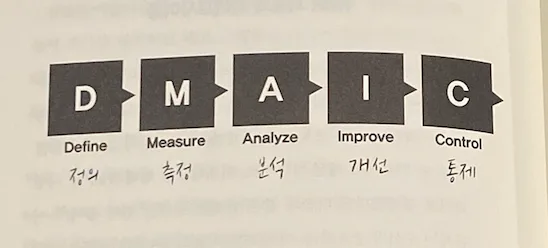
- Define
- First, select and define the metrics to measure. Choosing the right metrics provides clear guidance for action. Donald Wheeler explains this in Understanding Variation as follows.
- Input metrics track things such as selection, price, and convenience. They can be controlled through activities such as adding catalog items, reducing costs to lower prices, or adjusting inventory to enable faster delivery.
- Output metrics such as orders, revenue, and profit are important, but cannot be directly manipulated in a sustainable way. Input metrics, by contrast, measure the factors that generate the desired results.
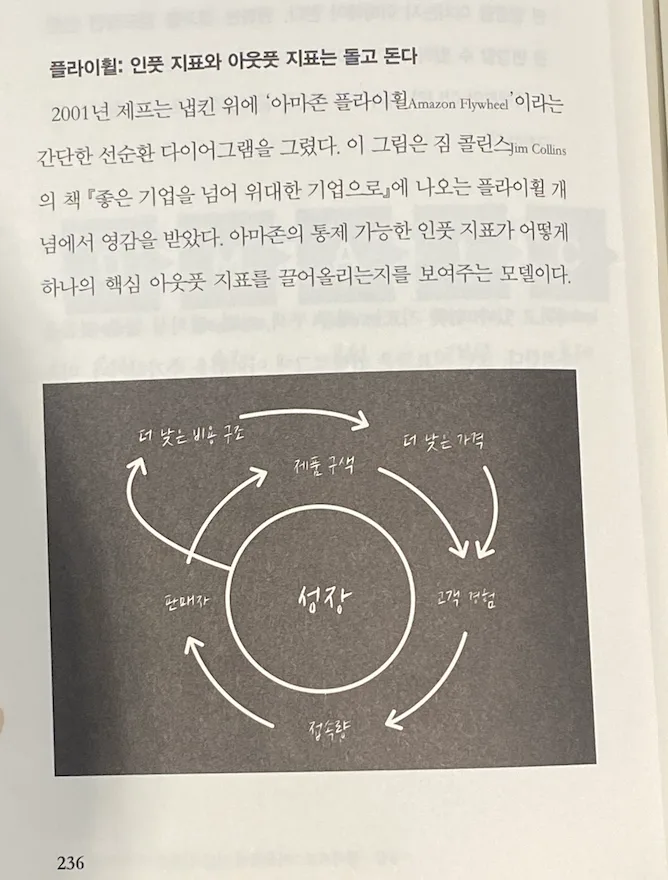
- The Flywheel: Inputs and Outputs Reinforce One Another
- In flywheel diagram (1) below, growth is the central output metric. In this closed-loop system, adding energy to any or all elements makes the flywheel turn faster.
- Because it is a cycle, you can start with any input. Inputs for customer experience include delivery speed, breadth of selection, rich product information, and ease of use.
- Identify the Right Controllable Input Metrics
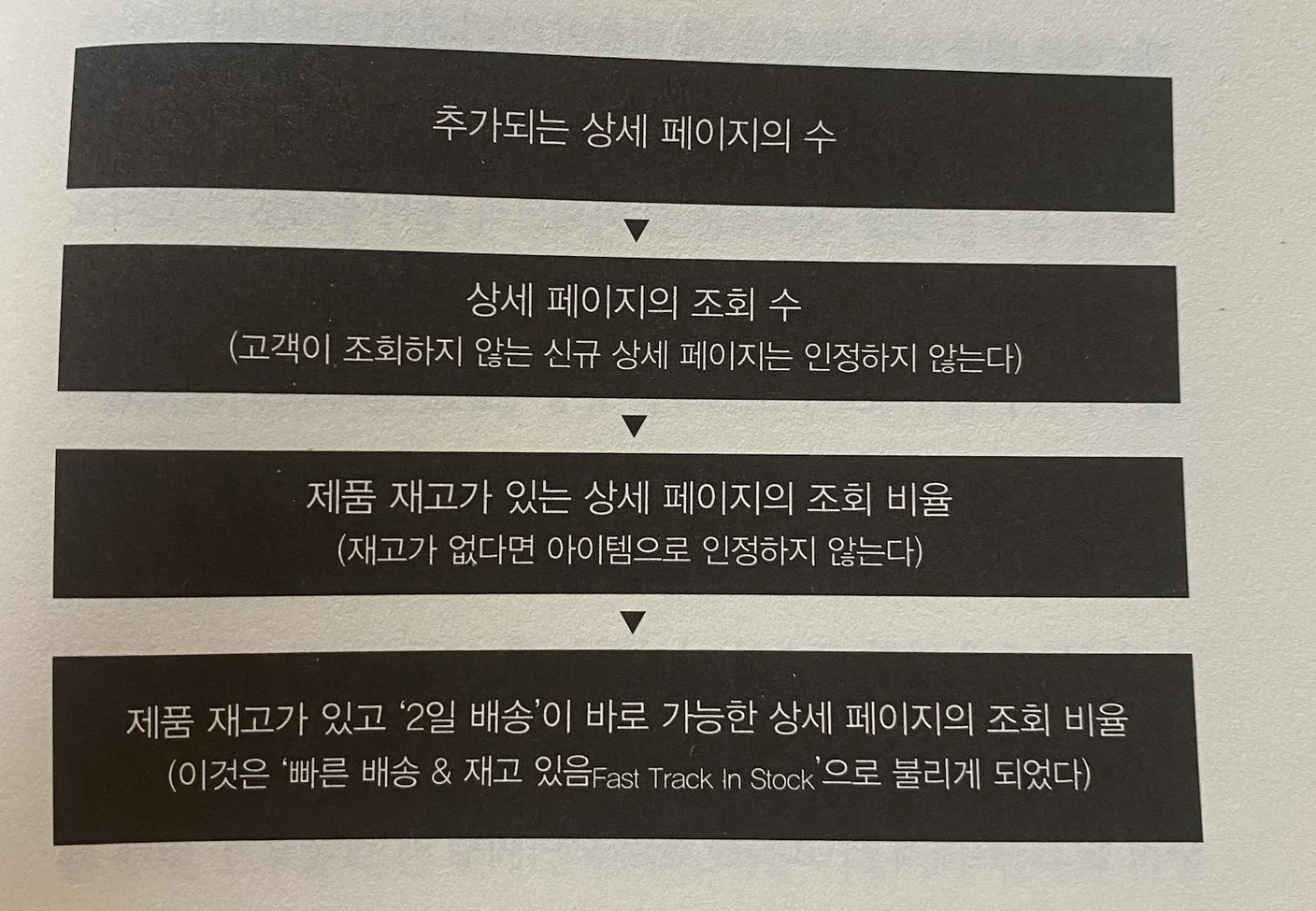
- This sounds simple but can be surprisingly tricky. When Amazon expanded beyond books, one mistake was choosing an input metric focused on selection: the number of items offered for sale. The chosen measure was the number of new detail pages. Adding enormous numbers of pages seemed to improve selection, but did not increase sales, an output metric. It also worsened inventory carrying costs, another output, by filling expensive fulfillment-center space with low-demand items.
- Through the WBR, Amazon realized the retail team had chosen the wrong input. A series of meetings refined it to reflect consumer demand. Could changing the selection metric produce the desired output? By collecting more data and closely observing the business, Amazon evolved the metric as shown below.
- The preceding metrics reveal a pattern of trial and error, an essential part of selecting metrics. The key is continual testing and discussion. Jeff worried that the fast-delivery-and-in-stock metric was too narrow, while Jeff Wilke argued it would produce broad, systematic improvements in retail. After observing it for a while, results followed Wilke's prediction.
- Once a metric is established, you can set a standard and evaluate teams against it. Amazon set a target of 95 percent for fast-delivery-and-in-stock availability when counting detail-page views.
- Focusing on the right inputs concentrates the entire organization on what matters most. Finding those inputs is therefore an essential, iterative process.
Before improving any system, understand how its inputs affect its outputs. To achieve the desired results, you must be able to change those inputs. This requires sustained effort and consistency of purpose, as well as an environment that treats continual improvement as an operating philosophy.
- Measure
- Building tools to collect metric data may appear straightforward. Removing bias is equally important. In Amazon's early years, business leaders revealed biases when selecting metrics and gathering data because they wanted to show their departments moving in a positive direction.
- In the early 2000s, Jeff and CFO Warren Jenson emphasized the importance of finance revealing and reporting the unvarnished truth. This truth-seeking mindset spread through the finance team and became an important foundation for leaders making broad-minded decisions based on facts.
- Take the in-stock metric. We might ask what percentage of our products can be purchased and shipped immediately.
- Method 1: Review the entire catalog at 11 p.m. each night, identify which items are in stock, and weight each item's importance using its sales over the preceding thirty days. If product A sold thirty units and product B sold ten, and both are out of stock at measurement time, A affects the metric three times as much as B.
- Method 2: Add software to product pages that increments a total-page-view counter whenever a page is displayed and an in-stock-page-view counter whenever the displayed product is marked in stock. Divide in-stock page views by total page views to obtain that day's overall in-stock metric. Products customers view frequently then affect the metric more than rarely viewed products.
- Because the two metrics measure availability differently, they can produce different results for the same business on the same day.
- The first metric can distort the data depending on when large inventory deliveries arrive. If most inventory arrives late at night, an item may have been unavailable all day but still produce a good in-stock result. The company would miss what many customers actually experienced: being unable to buy because the item was unavailable.
- The second metric costs more to collect, but captures availability at the moment customers view an item.
- The first metric is inward-looking and operations-centered; the second is outward-looking and customer-centered. Even when gathering metric data, we can practice working backwards by starting with customers and carefully considering their experience.
→ Measure the proportion of stocked products among all products → In-stock rate
→ Measure the proportion of in-stock product views among all product views → In-stock rate
- Analyze
- The purpose of this stage is to separate the signal from the noise in the data.
- Why can a fulfillment center pick a hundred items per hour under some working conditions while another shift handles only thirty?
- Why do most pages display within a hundred milliseconds while some take ten seconds?
- Why are customer-service requests per order always highest on Mondays?
- Whenever Amazon teams find a surprising or puzzling problem in the data, they pursue it relentlessly until they find its root cause. One of the most widely used techniques is Correction of Error, or COE.
- When an anomaly appears, ask why it happened, then keep asking why until the underlying cause is exposed.
- The likelihood of identifying the real root cause within the first twenty-four hours of encountering a problem is close to zero.
- By concentrating on identifying and eliminating errors' root causes, you eventually develop an optimized process that is predictable and controllable.
- Improve
- For example, once you reliably achieve a 95 percent in-stock rate every week, ask what changes would get you to 98 percent. Completing the first three stages improves your chances of success because you respond to signals rather than noise.
- After running the WBR for a while, you will recognize metrics that no longer provide value. Remove them decisively.
- Control
- The final stage checks whether a process operates normally and whether performance degrades over time. It also identifies processes to automate. Well-understood processes and decisions whose software and hardware logic can be encoded are potential candidates.
- Forecasting and purchasing are prominent examples of automation at Amazon. Applied across hundreds of millions of catalog products, they handle work once performed manually by many buyers with far greater precision.
Comments —