2024 Review: Infinite Game
A year of running at full speed has come to an end. Alongside developing VARCO Texture, I finished my undergraduate degree and submitted papers to conferences such as SIGGRAPH and CVPR for the first time. My time at NC, which began with an internship, is now set to continue as a team lead. By most measures, it was a productive year. Yet as the year drew to a close, I burned out. I suspect it was because the product I had led did not receive the response I had hoped for. I wanted even one customer to adopt it in their actual work and find it useful, but that did not happen. (Our main goal for 2024 was actually 100 users within the company. My forecasting was terrible.) I know it is not easy to introduce new technology or services into someone's daily workflow. Perhaps the real cause of my burnout was a failure to manage expectations. This was the goal that mattered most to me, which made the disappointment all the greater. I need to set appropriate goals, manage my expectations, take breaks along the way, and find a sustainable pace that keeps burnout at bay. As for exactly how to do that, I will need to think a little more…
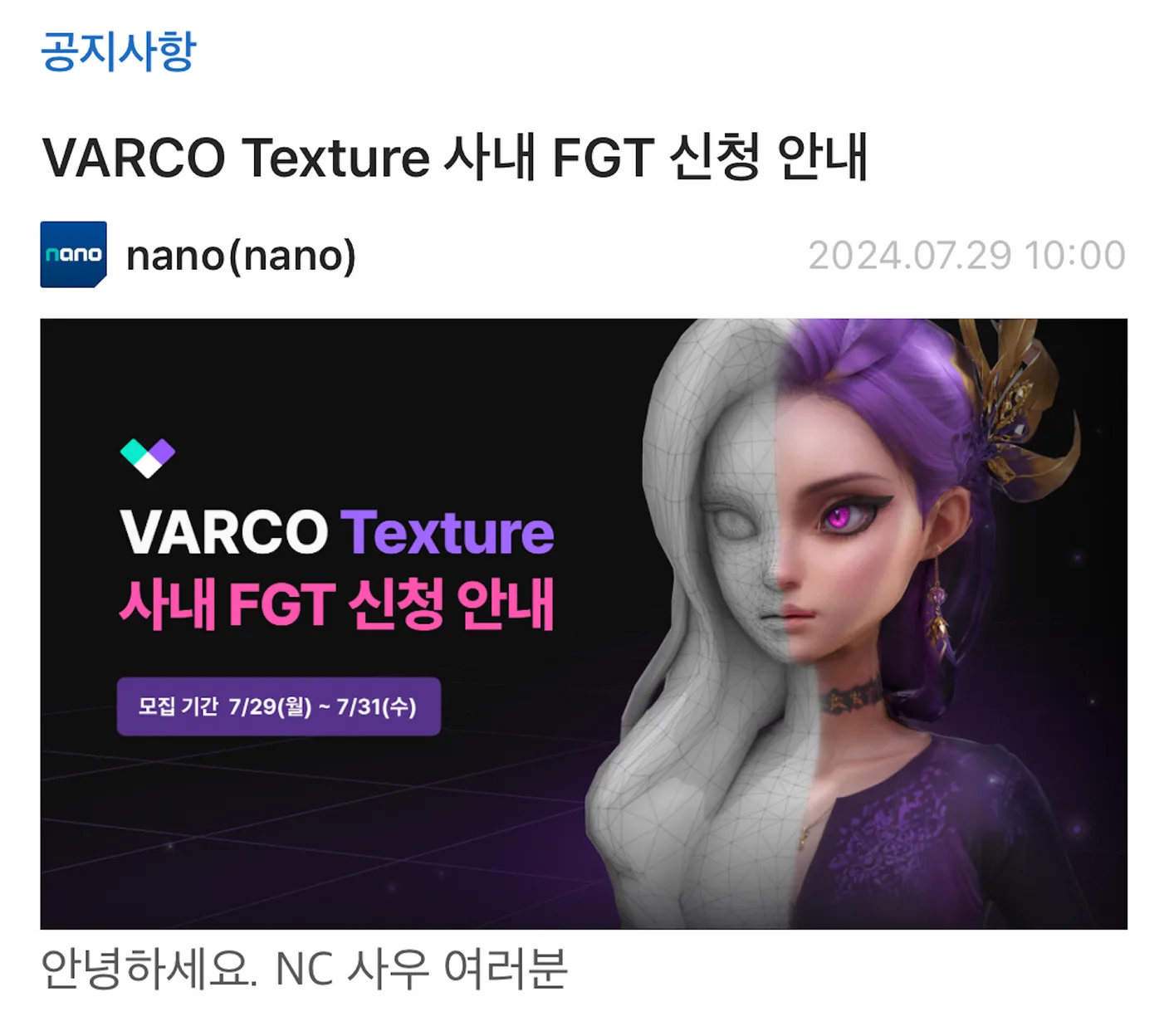
One thing I want to give myself credit for is keeping the team grounded and moving forward amid all the turbulence and issues at the company this year. We also did a reasonably good job of packaging an AI product and bringing it to market. We officially completed our first internal FGT (Focus Group Test), and I earned the trust to take on a formal team-lead role. That means another opportunity to take the initiative in planning and launching a service in 2025. I seem to have developed some know-how in researching an AI product over this kind of time horizon and running a team that serves it reliably. Whether the product succeeds is a separate question. I also learned that the team itself is a product. The team I worked with this year was genuinely excellent. It is disappointing that we could not keep it together, but perhaps if I build another good team and make a few more attempts, we can create a good product. I have only tried twice so far. Surely I should try at least three times. (And if the third attempt does not work, I will make a fourth.)
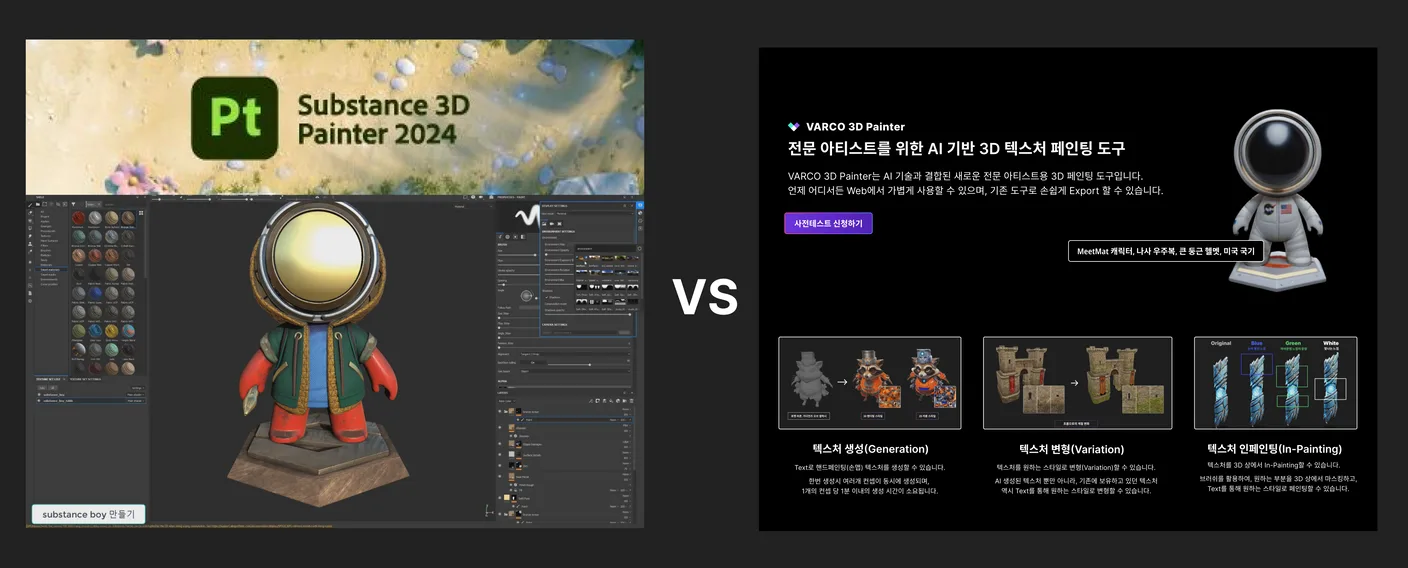
Looking back at what I fell short on, I was building AI to help with texturing without really understanding the work of texturing in depth. I planned features and developed the product without the essential understanding of which tools artists use, what stages they go through, or where they encounter friction. I did meet and carefully interview many artists, including 3D modelers and concept artists. Developing and launching several versions also greatly improved my overall understanding of texturing and modeling. But as someone who did not do this work myself, I never reached the level of deep empathy that comes from firsthand experience. Texturing had already made a major technological leap through Substance 3D Painter. Most 3D modelers felt that once they had a solid concept, Painter could quickly produce almost any look at high quality. In other words, they did not feel much dissatisfaction with texturing itself. Some older live games still rely mainly on Photoshop, and their teams did express a need to reduce the repetitive work of creating variations of existing textures in different styles. Yet they would try the feature once or twice and never come back. I learned that serving professional artists who need game-ready quality would be difficult when using generative AI requires giving up precise control over details.
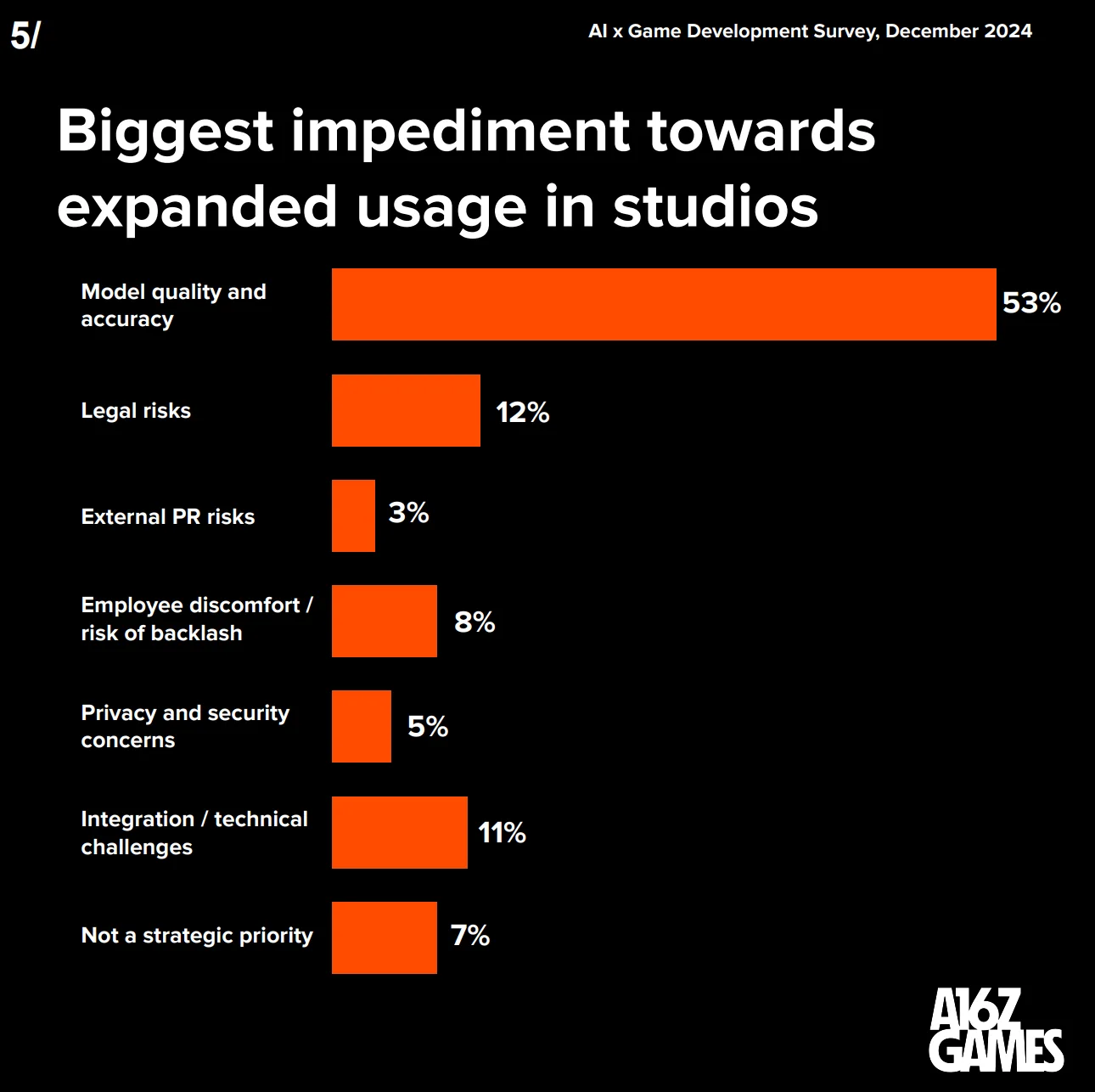
Even if I had started with a deep understanding of 3D modeling and texturing, and genuine empathy for the game-art workflow, I would probably have reached the same conclusion: AI-generated output is not yet good enough for in-game art production. The a16z Games survey reached a similar conclusion. Does that mean our only option is to do more AI research and improve quality? I still do not have an answer. Even if that were the right answer, pursuing the world's most competitive 3D foundation model seems reckless. We do not have the people or resources, and the competition is fierce across academia, big tech, and startups alike. There is one battle over 3D foundation models, led largely by universities and large companies, and another over services such as Meshy, Tripo3D, and Rodin. We would probably be better off leveraging emerging open-source research, such as TRELLIS, and finding differentiation outside the technology itself. Possibilities include models trained on proprietary 3D data from game IP, a UI and UX that retain a particular group of users, or 3D generation APIs tailored to users of a specific game, such as the 3D printer in Krafton's inZOI. We need to keep thinking about these differentiators while rapidly testing a range of hypotheses.
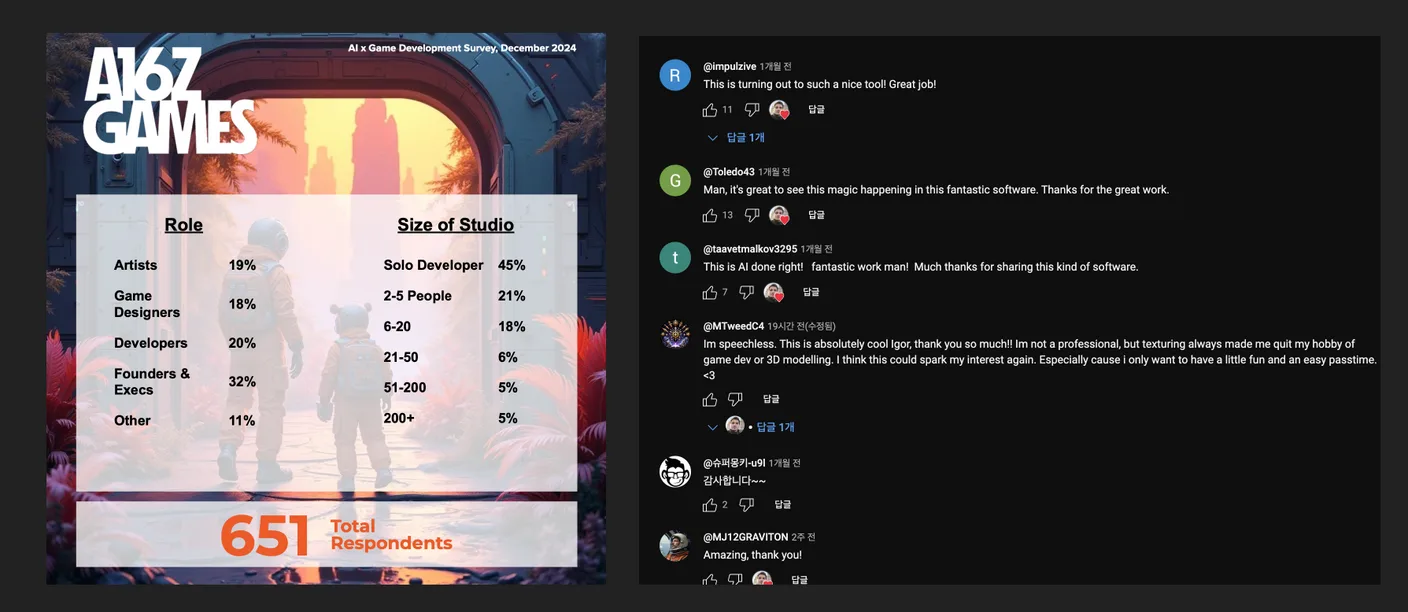
The audience for generative AI cannot be defined as simply professionals or nonprofessionals. We need a different category: people who are enthusiastic about AI and eager to use it—AI early adopters or AI enthusiasts—and we need to bring them together. Nor should we limit ourselves to NC's internal development process, which revolves around some of Korea's top artists. We should move into a larger market, ideally a global one. One product similar to VARCO Texture that seems to be doing well is StableProjectorZ, an AI tool for generating and editing textures. Its solo developer, Igor Aherne, is building a community through YouTube and Discord. Since its quality and usability do not seem dramatically different from ours, I think the difference lies in audience selection and marketing. The community includes both professionals and nonprofessionals. The quality limitations we saw as problems seem to be softened by qualitative factors: a distinctive sense of connection and shared anticipation within the community. In 2025, I hope we can pursue these strategies—experiments with different audiences and community building—more aggressively.
My hope for 2025 is to become a little lighter. To enjoy the process. To approach it sincerely, without taking everything too seriously. To keep building excellent products with motivated people in a sustainable way. To understand, and truly internalize, that this is an infinite game rather than a finite one. Instead of reaching the end of the year depleted, I hope to feel more fulfilled. Here's to 2025.
Comments —